

Developing Adaptive Flexibility
Summer development session that focuses on decision making & concepts

🤔 Thought Starter
⛹️ 60-Minute Workout: Adaptive Flexibility
🎶 The Playlist
🤔 Thought Starter
(Stanford Professor James) March’s 1991 paper highlighted the fundamental tension between what he dubbed exploration, encompassing “search, variation, risk taking, experimentation, play, flexibility, discovery, innovation,” and exploitation, encompassing “refinement, choice, production, efficiency, selection, implementation, execution.”
You can exploit the knowledge and resources you already have, or you can explore in search of an outcome that is uncertain but might turn out to be better.
- Alex Hutchinson, The Explorer's Gene

⛹️ Developing Adaptive Flexibility
We just wrapped up our regular summer development sessions and will pause until mid-August, when our state’s governing body restricts the type of contact we can have with high school players.
In July, we held development sessions on Tuesday, Wednesday, and Thursday mornings from 7:45 to 9:00 a.m. Each session was 75 minutes long, with the first 10 minutes set aside for players to get shots up on their own. The remaining time focused on structured development situations that I facilitated.
These sessions were run on a drop-in basis to accommodate players involved with club teams, other sports, or family vacations. Attendance varied from day to day, which used to frustrate me … especially considering I spent 20+ minutes crafting detailed practice plans with every minute accounted for.
Now, I’ve shifted my approach. During my drive to the gym, I settle on a couple of points of emphasis and build once I see how many players are in the gym. A typical session includes finishing and shooting activities, followed by small-sided games (SSGs) that reinforce our concepts. If 10 or more players attend, we often devote the final third of the session (or more) to 5-on-5 play.
Over the next couple of months, I’ll share breakdowns of a few of these sessions. My goal is to create a resource not just for the coaches on my staff, but also for the youth coaches in our community. I hope this series proves helpful and gives you some ideas to use in your own setting.
When I say I build a “practice plan” on the spot based on attendance, it’s important to note that the sessions are still grounded in key principles.
When I say I build a “practice plan” on the spot based on attendance, it’s important to note that the sessions are still grounded in key principles.
The foundation of our approach is rooted in the Ecological Dynamics framework. At its core is the belief that decision-making in game-like, representative scenarios is essential for developing players in invasion sports like basketball.
For example, with six players at one recent session, we opened with a 1v1 activity that allowed for “repetition without repetition” during the first 10 minutes — our version of a warm-up. In this case, we gave the offensive player an advantage and asked them to react based on the defense, helping us sharpen decision-making and skill execution in context.
(A few years ago, I created the resource below for my assistant coaches from a 🏀🎧 John Leonzo post on different drill starts.)
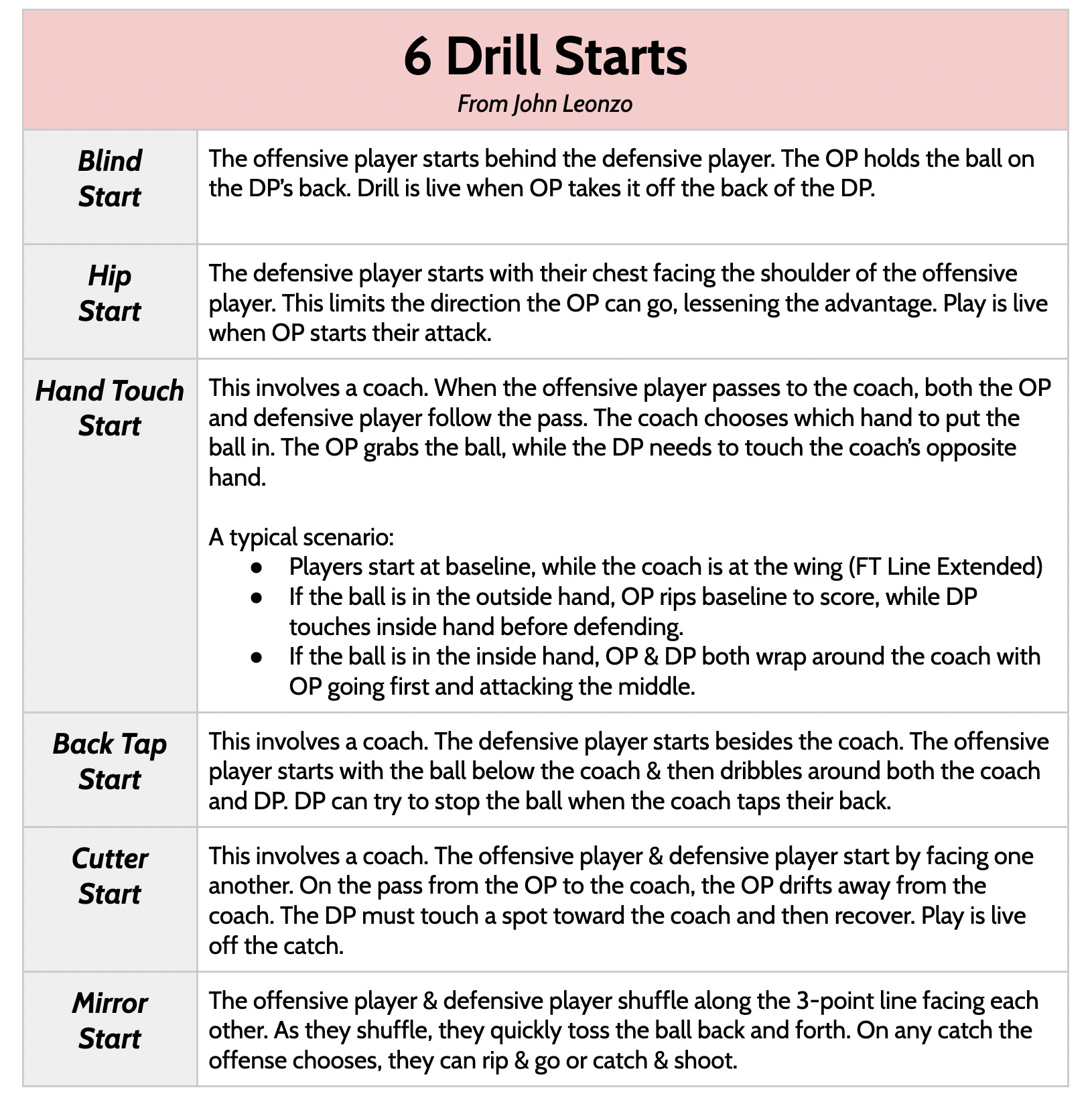
1v1 Reaction w/ Cones
This is a simple scenario designed to help players develop Adaptive Flexibility — the ability to recognize and exploit opportunities as they arise on the court. In this activity, the defender begins by choosing a cone to touch, while the offensive player uses the opposite cone to gain an initial advantage. To further support the concept of repetition without repetition, groups continuously rotate through different spots on the floor.
The drill was broken down into three progressive phases for the offensive player:
Drive
Shoot
Drive or Shoot
The defender’s role is to provide a light contest — not trying to block the shot, but creating enough pressure for the offensive player to feel their presence and respond accordingly.
🛠 To increase complexity, add a coach or another player as a help defender on drives. Place them in varying locations around the basket to force the offensive player to read and adapt their finishing angles and decisions.
2v2 Reaction w/ Cones
Building off the previous scenario, we kept the same starting action but extended the cones further out and transitioned into a 2v2 setup. For this session, the second offensive player was positioned in the opposite corner.
The ball handler had the option to finish or pass off the initial drive, depending on their read of the help defender. We gave the corner player full freedom — they could hold their spot, cut, or lift, based on what they saw.
Note: Middle school players often default to standing inside the 3-point line when off the ball. We consistently emphasize the concept of proper Spacing i.e. “4-point Line” spacing to maintain driving lanes and stretch the defense.
🛠 To vary the scenario, reposition the second offensive player in different spots on the floor. This forces the defense to adjust and challenges the offense to recognize new reads and spacing cues.
3v3 Concepts: Wing-to-Slot On-Ball w/ Dunker Spacing
The bulk of the session was devoted to teaching concepts through a 3v3 scenario, inspired by a conversation I had with 🏀🎧 Alex Sarama about playing with multiple bigs.
In our case, players were introduced to using the Dunker spot as part of our offensive structure. To create the scenario, we ran a wing-to-slot on-ball screen … something we may use as an initial or secondary Trigger this winter. While the drill introduced reads for the player in the post, it wasn’t limited to just post play.
With our younger group still new to conceptual offense, this setup also served as a great opportunity to explore on-ball coverage solutions. Rather than isolating and drilling every potential option, we discussed a few core ideas and then allowed the players to discover solutions through play.
In the edited video below, you’ll see how the actions and reads evolved naturally …both for the two players involved in the screen and for the player working out of the Dunker spot. Concepts like Rejects, Pops, Ghosts, and Wheel Unders began to show up organically, and it was exciting to watch the interplay develop between our middle schoolers and underclassmen.
🛠 When the initial action doesn’t create an advantage, introduce a Secondary Trigger. In the first clip, you’ll see the perimeter players struggle to create anything once the initial action stalls and the possession enters Neutral. I spent about 30 seconds introducing the concept of a DHO (dribble handoff), and just a few possessions later, the players used it to re-trigger the offense and effectively generate an advantage.
2-Minute Shooting: 3-Pointers
We wrapped up the session with a 2-minute 3-point shooting segment for each player … something we’ve been tracking since the spring. Currently, two players are tied for first with 29 makes.
🛠 Reminder: Rebounders are developing skills too. Encourage them to work on timing, communication, and passing accuracy during the drill. 😁
🎶 The Playlist
Fun stuff, William! I run some sessions where the numbers can vary, and it used to frustrate the hell out of me, too!!
I used this concept with an NBA point guard, which might help give your players a blueprint to follow during your read-and-react actions. Here's the link:
https://open.substack.com/pub/lowmanhelp/p/the-blueprint-cracking-the-shell?r=2wmouo&utm_medium=ios
Good luck this season!